
Ask the games industry how it plans to keep communities safe in 2026 and you’ll get a fairly consistent answer: AI.
The AI content moderation market is on track to grow from roughly $3.07 billion in 2025 to $3.88 billion in 2026. Detection that used to take hours of human review can now be done in seconds. Voice moderation, which barely existed as a product category a few years ago, is being deployed across live platforms.
And let’s be honest, the people doing the work have already adopted it. CMX’s industry survey found 93% of community professionals now use AI tools. This isn’t a future-facing debate, it is our current baseline.
And you know what? They work. AI can catch things humans miss (and oftentimes, catch them faster). For any community operating at scale, AI moderation tools (like detection tooling) is seen as a need-to-have.
But detection is only one part of the job. And the industry has started treating it like the whole job.
When we surveyed our pilot cohort (84 community managers, moderators, and digital leaders across 20 countries and six continents) the answers were not about tooling.
The most commonly named gap was wellbeing, self-care, and burnout. Many described the emotional cost of this work as something that goes unacknowledged in formal training, let alone addressed. De-escalation and conflict resolution came a close second. Roughly one in five named the professionalization of the field itself as the gap — the absence of standards, recognition, and career infrastructure that other disciplines take for granted.
Across all eight competency areas we measured, the most common amount of formal training reported was none.
The field’s most-cited training needs are relational, ethical, and structural, while the field’s most-funded solution remains technical.
Here’s what often gets overlooked in discussions about AI moderation.
A classifier surfaces a message. It might even tell you it’s the third escalation this week and draft a reply. But someone still has to decide whether this is a moderation issue or a welfare issue, and be accountable for that call. Someone has to sit with the person who was targeted.
None of that is a detection problem. All of it lands on a human, and usually one who told us they’ve had no formal training in exactly these areas.
Better tooling doesn’t remove that human. It routes more to them, faster. A studio that invests heavily in detection and not at all in the people receiving the output hasn’t solved its safety problem. It has built a more efficient pipeline into an untrained decision-maker.
I’ve long described trust and safety as a triforce: tooling (and product), policy (and enforcement), and education (the human layer).
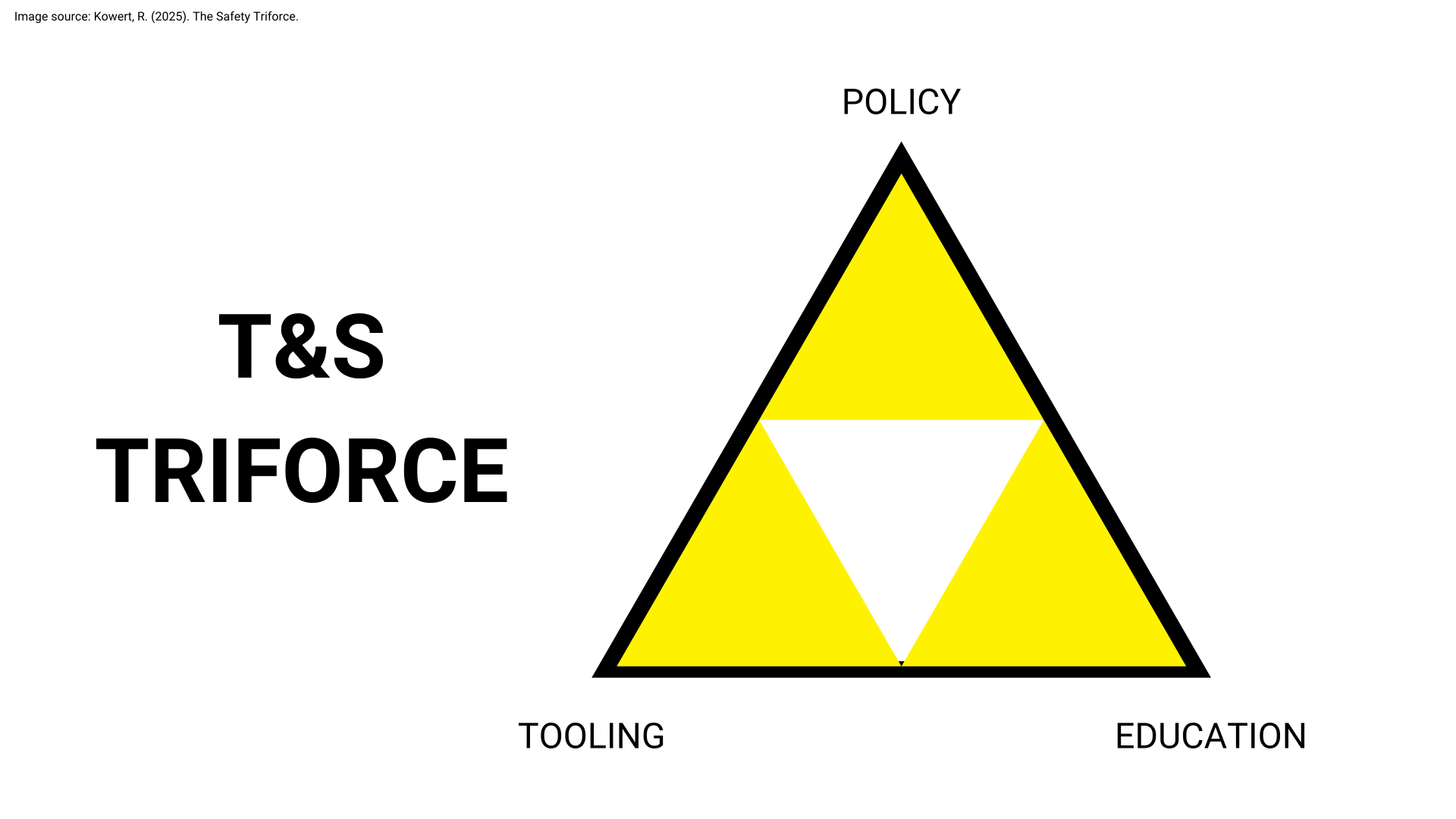
Tooling detects. Policy defines. Education is what determines whether the person holding the community together can actually act on either one.
Gaming has invested seriously in the first two corners for the better part of a decade. The third has been left to figure itself out, which in practice has meant Discord threads, hallway conversations at conferences, and a lot of people quietly learning by getting it wrong.
The results show up in the data. When people are given structured, evidence-based training in this work, they don’t just feel better prepared — they change what they do. 85% of graduates reported in the post-assessment that they had already changed how they lead before the program ended: new moderation practices, restructured guidelines, different approaches to conflict and safety.
That’s the corner the industry keeps underfunding. It’s also the one that moves fastest when someone finally invests in it.
We are not here to make the case that AI has no place in community work. It absolutely does. We’re making the case that it can’t carry the whole load and that where it can help, leaders deserve to be trained in it properly rather than left to improvise.
That’s why we’re building a masterclass on using AI tools in digital leadership with Alice Hunsberger of Musubi (coming in 2027), discussing what these tools are genuinely good at. Where they fail. How to build them into a workflow without handing over the judgment calls that shouldn’t be automated.
The choice here is not “AI or humans.” It’s that AI raises the floor on detection, and training raises the ceiling on everything that happens next. You need both. Right now the industry is buying one and hoping the other sorts itself out.
If you lead a digital community, the DLC Leadership Program is free, evidence-based, and built from what practitioners told us they actually need. Real certification at no cost – join the waitlist!
If you’re a studio, publisher, or platform, your detection stack is only as good as the people acting on what it surfaces. Partnering with the DLC means training those people and helping build the professional infrastructure this field has been missing.
AI can flag it. Someone still has to lead through it.
Let’s make sure they know how.